Parlance is a live platform that keeps design and code in sync. It treats a design system as a contract — colours, spacing, components, terminology, and accessibility rules — and continuously audits everywhere a product lives: design files, code, the live product, and native apps. One engine, packaged as the @parlancelabs/sdk, drives a fast, keyboard-navigable web app built on the Lexicon OKLCH token system, and a family of extensions that put the audit wherever the team already works: Figma, Chrome, Firefox, Safari, VS Code, Xcode, iOS, and AI agents over MCP.

The challenge
Design systems drift the moment they leave the source of truth. A token gets hard-coded, a contrast ratio slips below 4.5:1, a label says "Click here", a radius is 6px where the token says 10px, and nobody notices until it ships. The problem was not building a system; it was enforcing one, everywhere, without slowing teams down.
- Tokens get hard-coded the moment design leaves Figma
- Accessibility regressions, contrast, targets, labels, ship unnoticed
- Design, code, live product and native apps drift apart
- Standards (WCAG 2.2, ARIA, Section 508, EN 301 549) are checked by hand, late
- Designers and engineers work in different tools with different truths
- One product, but findings look different on every surface

Discovery & research
Parlance began as a systems problem, not a screen problem: design systems drift the moment they leave the source of truth. Discovery mapped where drift actually happens, which accessibility standards have to be enforced rather than hoped for, and how one audit could read identically across eight wildly different hosts.
Drift happens at the edges, not the centre
A token gets hard-coded, a contrast ratio slips below 4.5:1, a label says 'Click here', a radius is 6px where the token says 10, and nobody notices until it ships. The conclusion was that a system has to be enforced everywhere the product lives, not just defined once in Figma.
EvidenceFour surface types scoped for audit: design files, code, the live product, and native apps.
Accessibility regressions ship silently
WCAG 2.2, ARIA, Section 508 and EN 301 549 are normally checked by hand, late, by whoever remembers. Treating them as structural guarantees, audited continuously and surfaced with severity, was a research conclusion that shaped the whole product, not a feature bolted on at the end.
EvidenceA 19-entry standards catalogue (WCAG 2.2, ARIA 1.2, Section 508, EN 301 549) audited across every surface, with severity-coded findings.
Colour has to be functional to survive eight hosts
For the same finding to read identically in a web app, a 360px Figma panel, a browser popup, a VS Code tree and an iOS screen, colour could not be decoration — it had to carry meaning. Severity and status are defined as tokens, in OKLCH, with light and dark values, so a critical finding looks critical everywhere. Light bases were deliberately darkened to clear 4.5:1 as text on white.
Evidence50+ OKLCH colour values (the Lexicon foundation), light + dark, with dedicated severity (critical/high/medium/low) and status (pass/fail/pending/warning) systems.
One contract, or it's just a suggestion
The research reframed the design system as a contract — tokens, components, glossary, accessibility — that every surface is audited against. Consistency you cannot enforce is only a suggestion, so the unit of the product became the contract, not the component library, packaged as one SDK every surface consumes.
EvidenceEight surfaces (Figma, Chrome, Firefox, Safari, VS Code, Xcode, iOS, MCP), all bound to one shared Lexicon contract.
How I approached it
Everything started from the token layer — Lexicon, built in OKLCH so colour stays perceptually even, with light and dark as equal modes and a functional system where severity and status get their own accessible treatments. From there the same language extended outward: the web platform for the full audit and system definition, then the surfaces where work actually happens — a Figma plugin, browser extensions, a VS Code extension, an Xcode extension, and a native iOS auditor — all consuming one shared SDK so the audit engine is written once and reused everywhere.
Built the Lexicon token foundation in OKLCH — neutrals, brand, severity, status, light + dark
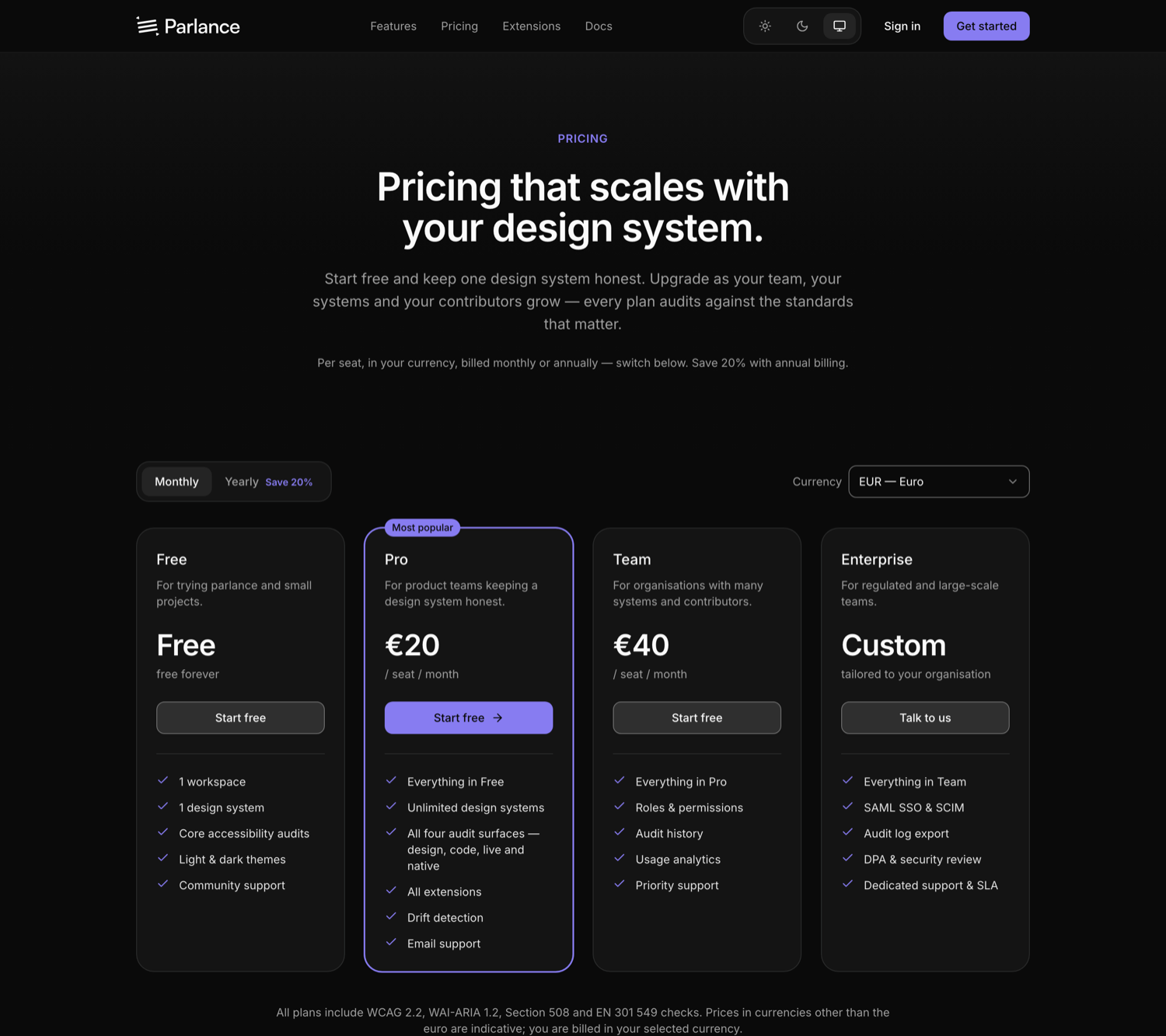
Designed the web platform and marketing site: audit detail, project overview, glossary, pricing, sign-in
Made colour functional — severity and status drive every finding, never decoration
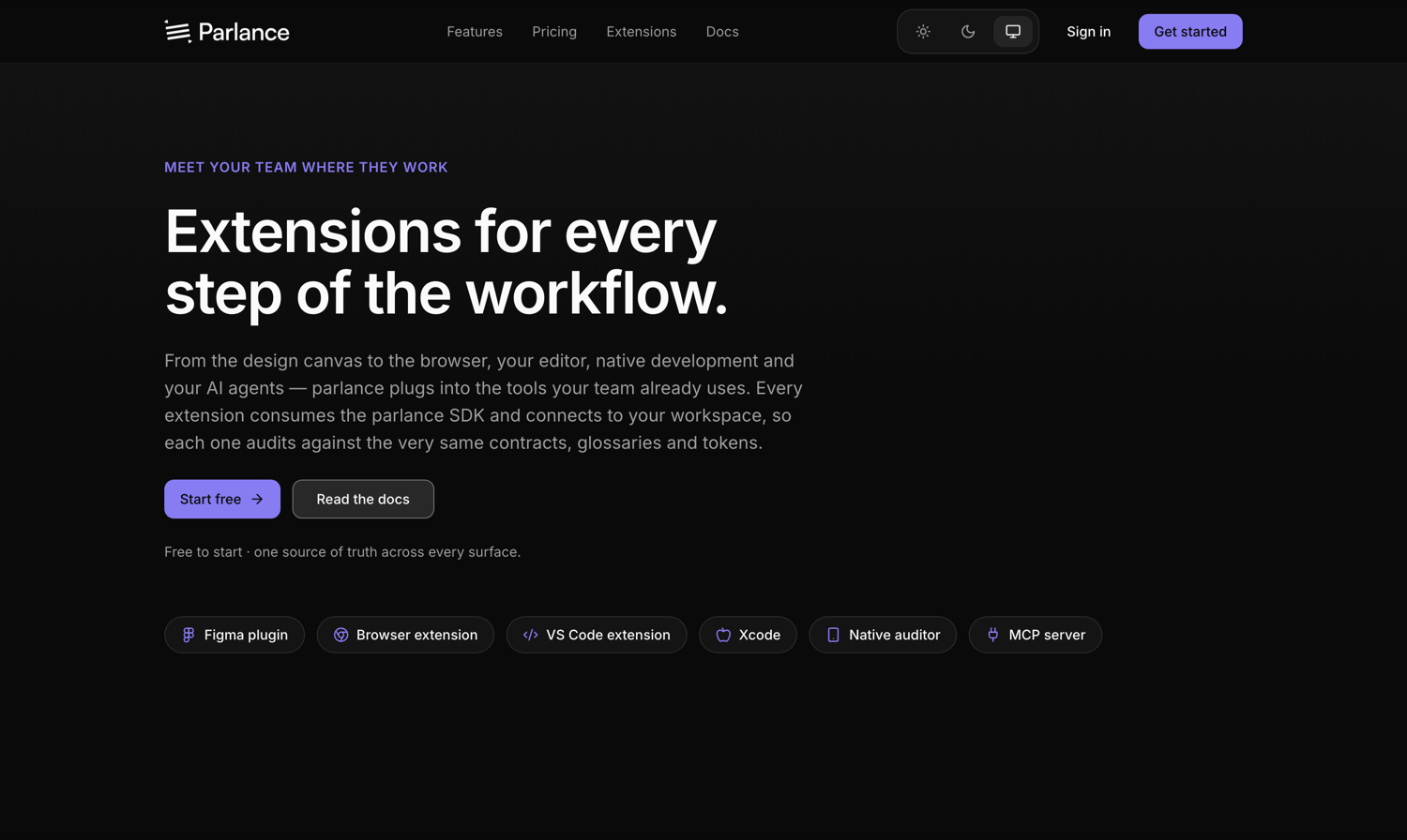
Packaged the audit engine as one SDK, then brought it to Figma, the browser, VS Code and Xcode
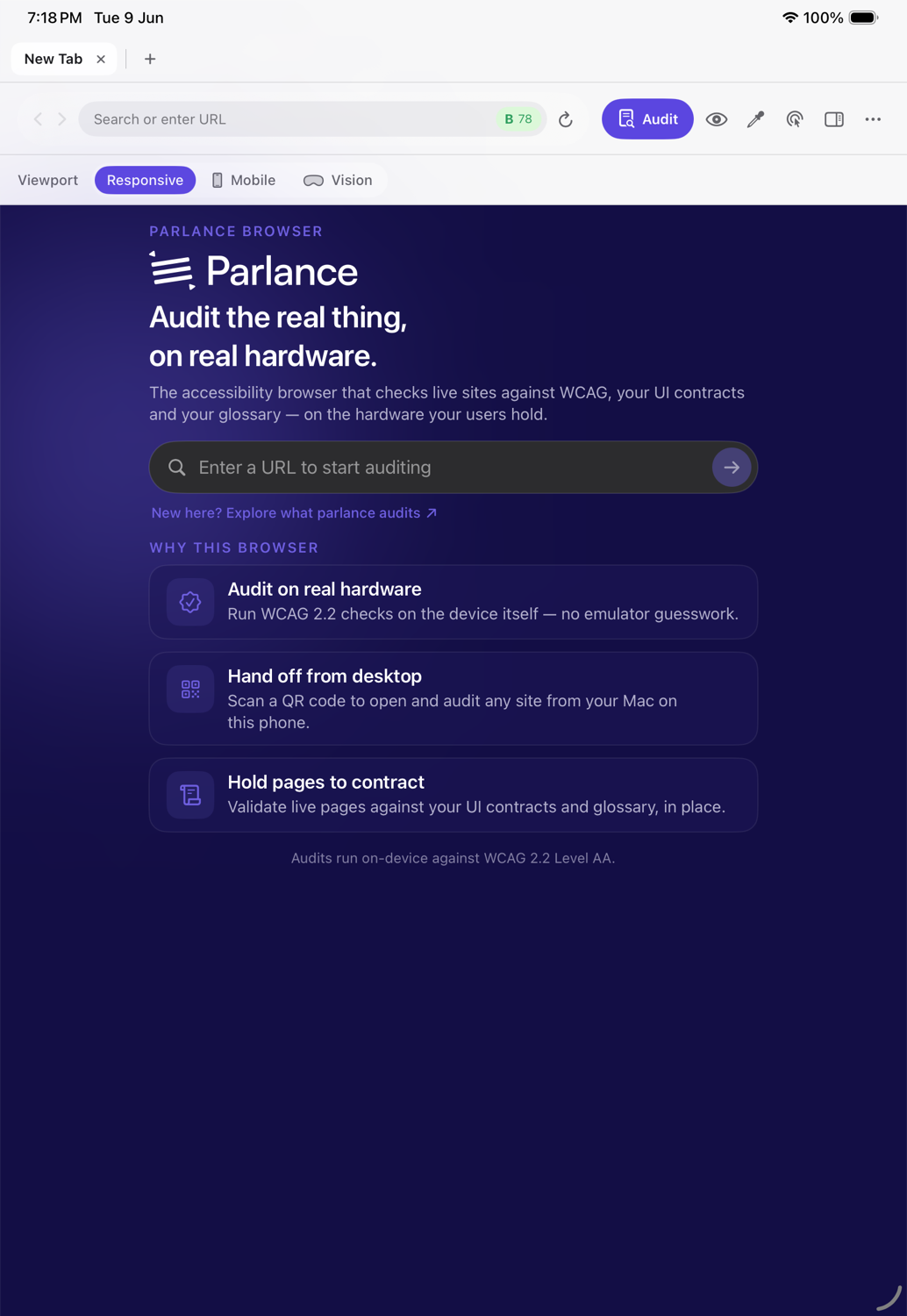
Designed the native iOS auditor (Parlance Browser) and an MCP server for AI agents
Held one contract across every surface, so a finding reads the same in Figma, Chrome and Xcode


Trade-offs
The challenge was coherence across radically different hosts. A 240px web sidebar, a 360px Figma panel, a browser popup, a VS Code tree view and an iOS screen have nothing in common structurally, but the product had to feel like one thing — and the audit data had to be instantly recognisable on all of them. Underneath, one engine had to be robust enough to ship as a paid product: six fix phases, four security waves and three audit rounds went into making the same contract hold on every surface without drifting.
- One language across web, plugin, extensions and native — wildly different hosts
- Keeping severity and status legible at every size and in every theme
- Designing dense, data-heavy audit views that still scan quickly
- Light and dark as equals on every surface, never an afterthought
- Making the same finding feel native in Figma, Chrome, VS Code, Xcode and iOS
- Hardening one engine into a paid product — security, correctness, and accessibility held under load

Final direction
Parlance is one contract enforced across eight surfaces beyond its web platform, live and paid at parlancelabs.net. The web platform and marketing site are the hub — they carry the full audit, glossary, pricing and system definition; the Figma plugin, three browser extensions (Chrome, Firefox, Safari), the VS Code and Xcode extensions bring the audit to the point of work; the native iOS Parlance Browser audits live and native experiences; and an MCP server exposes the same audits to AI agents. All of it is bound to the Lexicon token system through one SDK, so the whole platform flips to dark in a click and every finding is colour-true across hosts.

Outcomes
Parlance is a shipped, paid platform — not a demo. One token contract, packaged as a single SDK, is enforced across eight surfaces (Figma, Chrome, Firefox, Safari, VS Code, Xcode, iOS, and an MCP server for agents), with accessibility (WCAG 2.2, ARIA 1.2, Section 508, EN 301 549) and light/dark treated as structural guarantees rather than later passes. Getting there took the unglamorous craft: six fix phases, four security waves and three audit rounds to make one engine hold on every host at production quality. The contribution is the systems thinking that lets one language survive contact with a web platform and eight surfaces beyond it, and stay live.

One system, every screen
Keep design and code telling the same story.

A design system is only as strong as its weakest surface. Parlance treats the system as a contract and audits everywhere the product lives, because consistency you cannot enforce is just a suggestion.